A City That Could See Itself
How Tang Dynasty Chang’an Engineered Visibility, Control, and a Pre-Modern Logic of Systems Thinking
In the opening minutes of The Longest Day in Chang’an, a man runs—and the city runs ahead of him.
Zhang Xiaojing moves through the narrow wards of Tang Chang’an with the urgency of someone already outpaced. Above him, on timbered watch platforms, figures shift panels and flags in practiced silence. A signal appears, is read, and is sent on. By the time he turns a corner, the news of his movement has already arrived.
The scene does not feel ancient. It feels, in an unsettling way, familiar.
Not because it anticipates modern technology in any literal sense, but because it stages a recognizably modern ambition: to render the present visible, everywhere, all at once.
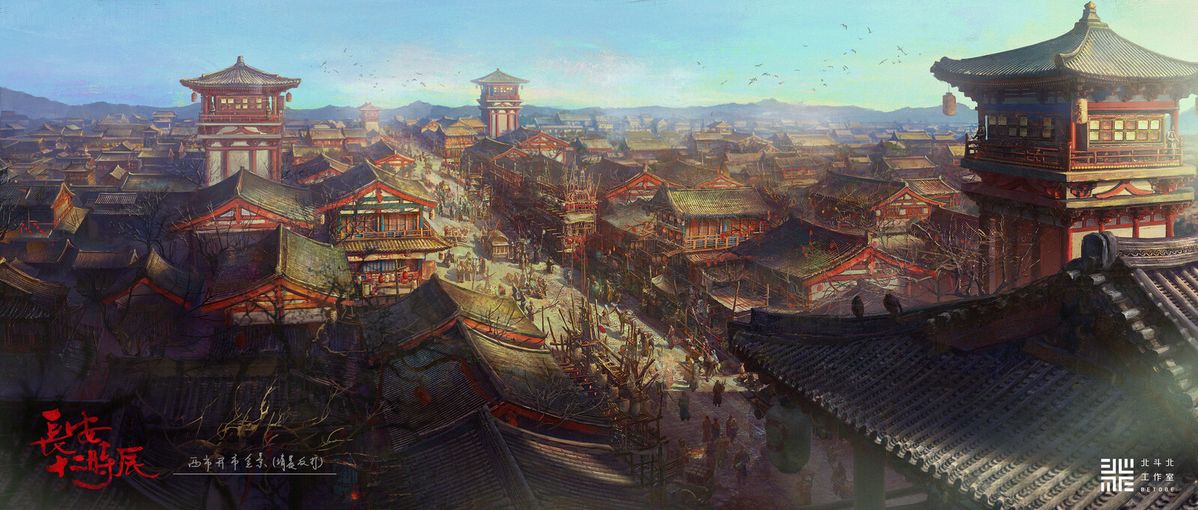 Chang’an as a designed system: visibility was not incidental, but engineered.
Source: Image from POLARIS Workshop.
The series imagines a bureau—Jing’an Si—tasked with holding the city in view. No such institution existed in this form. Control in Tang Chang’an was neither singular nor hidden; it was distributed across systems: ward administration, curfew enforcement, and elite units such as the Jinwu Guards. Surveillance was not centralized. It was ambient.
What the show makes tangible is the possibility of coordination.
Its network of watchtowers, or wanglou (望楼), is an extrapolation rather than a record. Historically, such towers served for observation and localized signaling, not for the continuous, citywide relay depicted onscreen.
Yet the underlying principle is well attested. Along the empire’s frontiers, beacon systems—fenghuo (烽火)—transmitted warnings across vast distances using smoke and fire. Speed was achieved not through technology alone, but through agreement: a fixed vocabulary of signals, understood in advance.
Meaning, in other words, was disciplined.
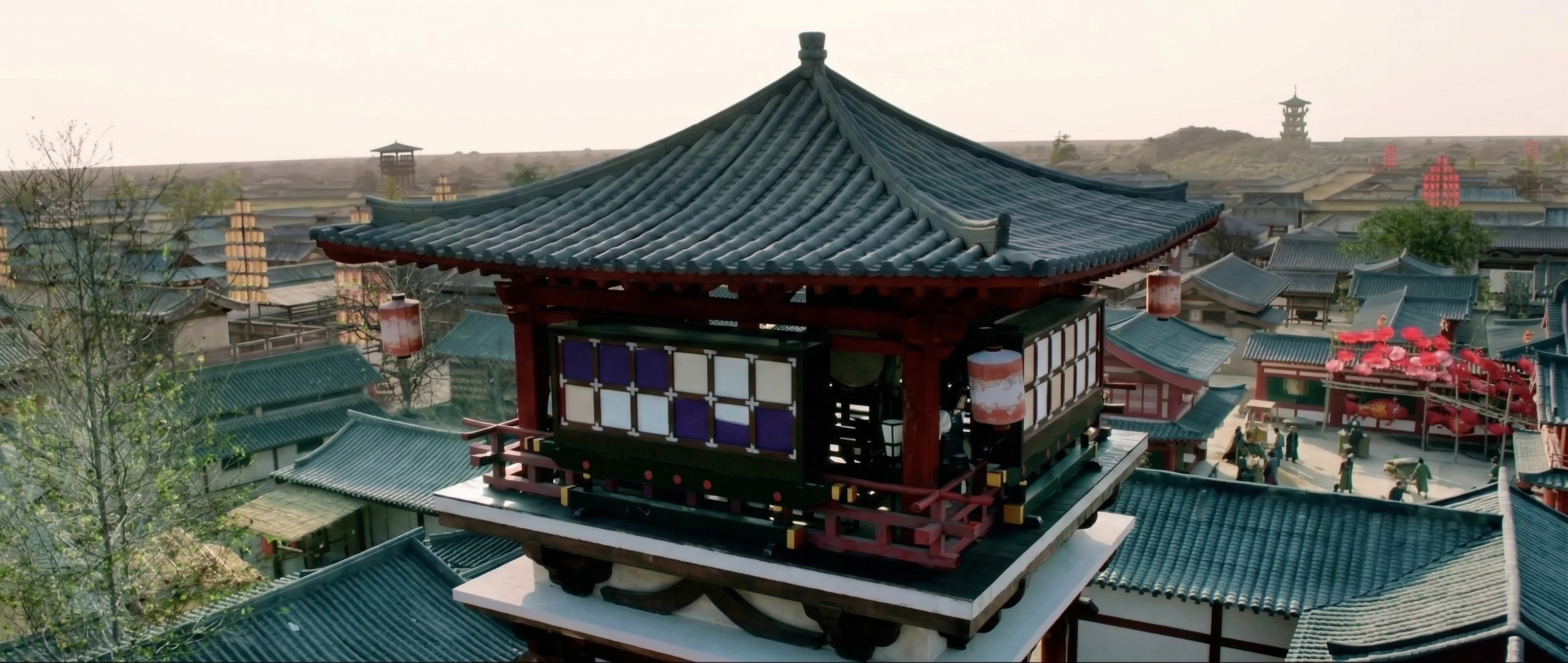 Predefined signals reduced ambiguity, allowing action without interpretation.
Source: Screenshot from The Longest Day in Chang'an.
The series folds this frontier logic inward, into the dense grid of the capital. Its visual language—panels flipping, signals cascading—invites comparison to digital systems. It is tempting to describe it as binary, to imagine each movement as a unit of encoded data. But that analogy belongs to us. Tang engineers were not digitizing information; they were eliminating ambiguity. A signal, once seen, required no interpretation—only response.
If the network is partly imagined, the city that sustains it is not. Chang’an in the eighth century was among the most rigorously planned urban environments of the premodern world. Its 108 wards formed a strict grid, enclosed and regulated by gates that opened and closed with temporal precision. Movement was structured; visibility was carefully managed.
The result was a city that could be read.
From above, Chang’an resolved into pattern. From within, it operated through segmentation. Governance depended not only on authority, but on form—the alignment of streets, the placement of thresholds, the predictability of motion.
Comparisons to Manhattan are often made, if only as shorthand. More revealing, however, is the contrast with contemporaries such as Baghdad or the Carolingian court at Aachen Cathedral, where urban order was less rigid, and authority dissipated more quickly into the surrounding fabric. Chang’an was different. It was designed to hold its shape.
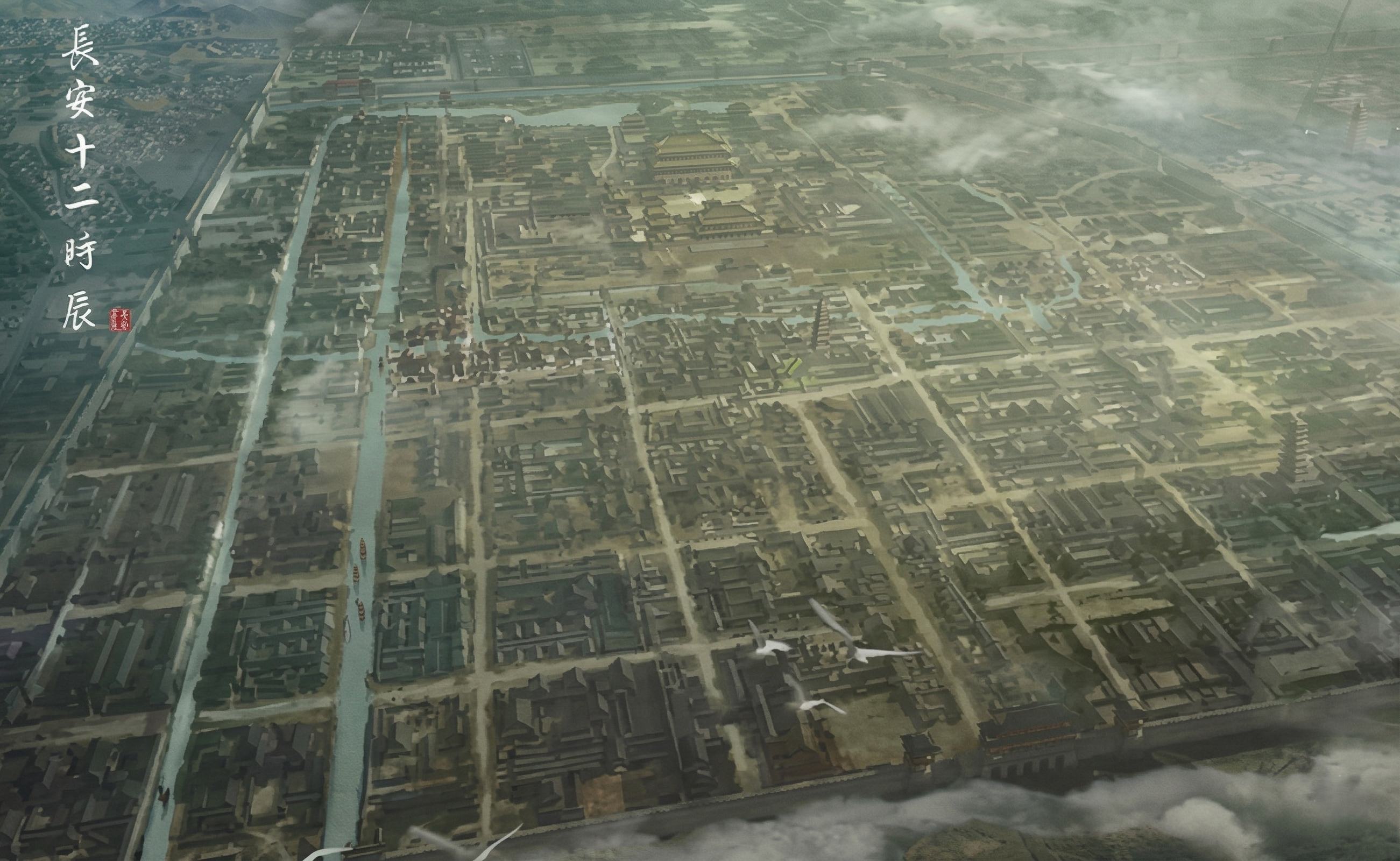 Order and legibility: Chang’an’s grid alongside more organic urban forms.
Source: Screenshot from The Longest Day in Chang'an.
What emerges, then, is not a story about premature modernity—no ancient analogue to digital networks—but about an enduring administrative instinct: to shorten the distance between event and awareness.
This instinct is, in part, what Ma Boyong captures with unusual precision. His work often reads less like historical reconstruction than like systems thinking applied to the past. Having spent formative years abroad—including a period at the University of Waikato—and later working in international logistics, Ma developed a sensitivity to flow: of goods, of information, of constraint. In The Longest Day in Chang’an, that sensibility surfaces not in exposition but in structure. The city behaves like a network because, in his telling, it is one.
The achievement of the series lies not in technological speculation, but in conceptual clarity. It offers a city that watches itself—not perfectly, not completely, but systematically.
We tend to think of such capacities as recent. Yet the underlying wager is older. To see sooner is to act sooner; to act sooner is, perhaps, to control.
Fourteen centuries later, the materials have changed. Signals move through fiber and spectrum rather than smoke and fabric. But the ambition remains intact—the belief that if the present can be rendered quickly enough, clearly enough, it might also be mastered.
Stand, for a moment, in that imagined Chang’an at dusk. The gates are closing. The lanterns rise.
Somewhere above you, someone has already seen what you have not.
And by the time you notice, it may already be too late to matter.
Image Credits
All images are used for illustrative purposes under fair use. All rights belong to their respective owners.
Support Independent Research If you enjoyed this analysis of Tang Dynasty systems, consider supporting Grandevity Studio. Your contributions fuel our independent research Support via Ko-fi.